
Fiber Optic Splicing in San Jose CA – Fusion Splicing & Repair
Precision fusion splicing for single-mode and multimode fiber: pigtail terminations, extensions, ribbon cables and restorations, each splice measured and recorded.
Splicing is part of our fiber optic cabling service. We splice fiber for offices, R&D campuses, data centers and industrial sites across San Jose and Santa Clara County.
- California C-7 telecom license (CSLB #[NUMBER])
- Core-alignment fiber splicer
- OTDR-verified splices
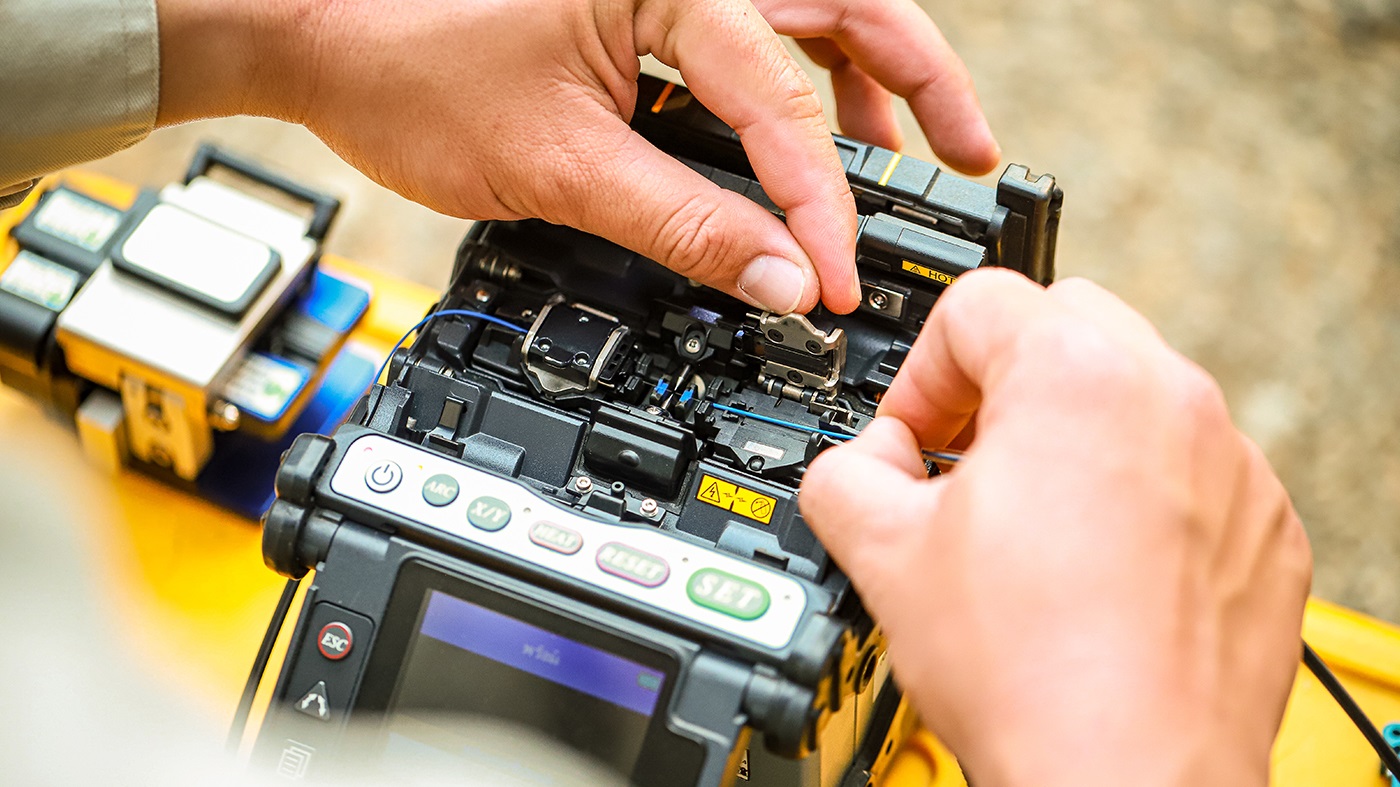
Fiber Optic Splicing Services in San Jose
Every type of splice your network needs, done by one crew with the same equipment and standards.
Pigtail splicing
Factory-polished LC or SC pigtails fused to backbone strands for low-loss fiber termination in rack and wall enclosures.
Mid-span splicing
Through splices that extend a run, add a branch or join new cable to an existing backbone.
Ribbon splicing
Mass fusion of 12-fiber ribbons for high-count cables, where splicing one fiber at a time would take too long.
Cable restoration
Damaged or cut cable located with an OTDR, then restored with new splices and a protected enclosure.
Splice enclosures and closures
Rack-mount and wall-mount enclosures indoors, and sealed splice closures in vaults and handholes outside.
Testing and records
Every splice verified by OTDR, with splice maps and test reports at handoff.
Splicing is one part of our complete fiber and network cabling service, from design and installation to final verification.
Fiber service overviewFusion vs. Mechanical Splicing in San Jose
Both join two fibers, but they perform very differently.
| Fusion | Mechanical | |
|---|---|---|
| How it works | An electric arc melts and joins the two fiber ends into one continuous strand | Cleaved ends are aligned inside a sleeve with index-matching gel |
| Typical loss | Very low, often under 0.1 dB with a core-alignment splicer | Higher, often a few tenths of a dB |
| Back reflection | Very low | Higher, which matters on some single-mode links |
| Best for | Backbones, campus links, single-mode and permanent installs | Quick temporary restoration and small fixes |
ANSI/TIA-568 allows a maximum of 0.3 dB per splice. Our fusion splices are typically well under that limit.
How We Splice in San Jose
A low-loss splice depends on careful preparation at each step.
Strip and clean
The jacket, buffer and coating are removed and the bare optical fiber is cleaned with lint-free wipes and alcohol.
Cleave
A precision cleaver cuts each fiber end flat and square, which is essential for a low-loss joint.
Align and fuse
The splicer aligns the cores and fuses them with an arc, then reports an estimated loss.
Protect
A heat-shrink sleeve with a steel strength member is placed over the splice.
Organize
Splices are seated in labeled splice trays with proper bend radius for the slack.
Verify
Each splice is measured with an OTDR, tested in both directions where accuracy matters, and re-done if it’s out of spec.
Splice Enclosures in San Jose
Every splice is protected in the right housing for its location.
| Location | Enclosure |
|---|---|
| MDF and IDF racks | Rack-mount splice and patch enclosures with splice trays and LC or SC adapters |
| Small telecom rooms | Wall-mount enclosures that combine splicing and patching |
| Building entrances | Entrance enclosures where outside-plant cable is spliced to indoor-rated cable |
| Vaults and handholes | Sealed dome or inline splice closures rated for moisture and burial |
When You Need Fusion Splicing in San Jose
Common splicing projects across San Jose and the surrounding cities.
New backbones
Termination by splicing
Pigtails spliced onto riser and campus fiber for the lowest possible loss.
Campus networks
Building entrance splices
Outside-plant cable joined to indoor cable at each building’s entrance enclosure.
Network changes
Extensions and branches
Existing fiber extended to a new IDF or building without replacing the whole run.
Damaged cable
Repair and restoration
Breaks found by OTDR and rejoined with fusion splices in a protected closure.
Splicing FAQs for San Jose
Quick answers to the questions we hear most.
What is splice loss?
It’s the light lost where two fibers are joined, measured in decibels (dB). Lower is better, and every dB counts against your link’s loss budget.
Fusion or mechanical splicing?
Fusion splices for almost every permanent install. Mechanical splices are mainly used for quick temporary fixes.
Can single-mode be spliced to multimode?
No. Single-mode fiber and multimode cores don’t match in size, so the joint would lose most of the signal. Each link should use one fiber type end to end.
Can a cut cable be restored?
Usually. We locate the break with an OTDR, splice in new cable if needed and protect the new joint in a closure or enclosure.
Related San Jose Services & Nearby Cities
Explore related pages, our other services, and the nearby cities we cover.
Nearby cities we serve
We also serve these 10 neighboring cities. Pick yours to see local service details.
Request a San Jose Splicing Quote
Tell us the fiber type, strand count and where the splices will be. We’ll schedule a site survey and return an itemized estimate covering splicing, enclosures, labor and OTDR verification for your systems.
C-7 Licensed Installer & Contact Details
San Jose Telecom Techs97 E Brokaw Rd, San Jose, CA 95112
Email: [email protected]
What to send before your site survey
- Single-mode or multimode, and strand count
- New termination, extension or restoration
- Splice locations (rack, wall, entrance, vault)
- Existing enclosures, if any
- Target completion date