
OTDR Testing & Certification in San Jose CA – Fiber Testing Services
Tier 1 power-meter certification and Tier 2 OTDR traces that prove every link meets spec, show exactly where every mated pair and fusion joint sits, and pinpoint faults by distance.
OTDR testing is part of our fiber optic cabling service. Our field service crews test new and existing glass for offices, R&D campuses, data centers and industrial sites across San Jose and neighboring cities, including broadband and internet entrance links.
- California C-7 telecom license (CSLB #[NUMBER])
- Tier 1 and Tier 2 certification
- Bidirectional OTDR analysis
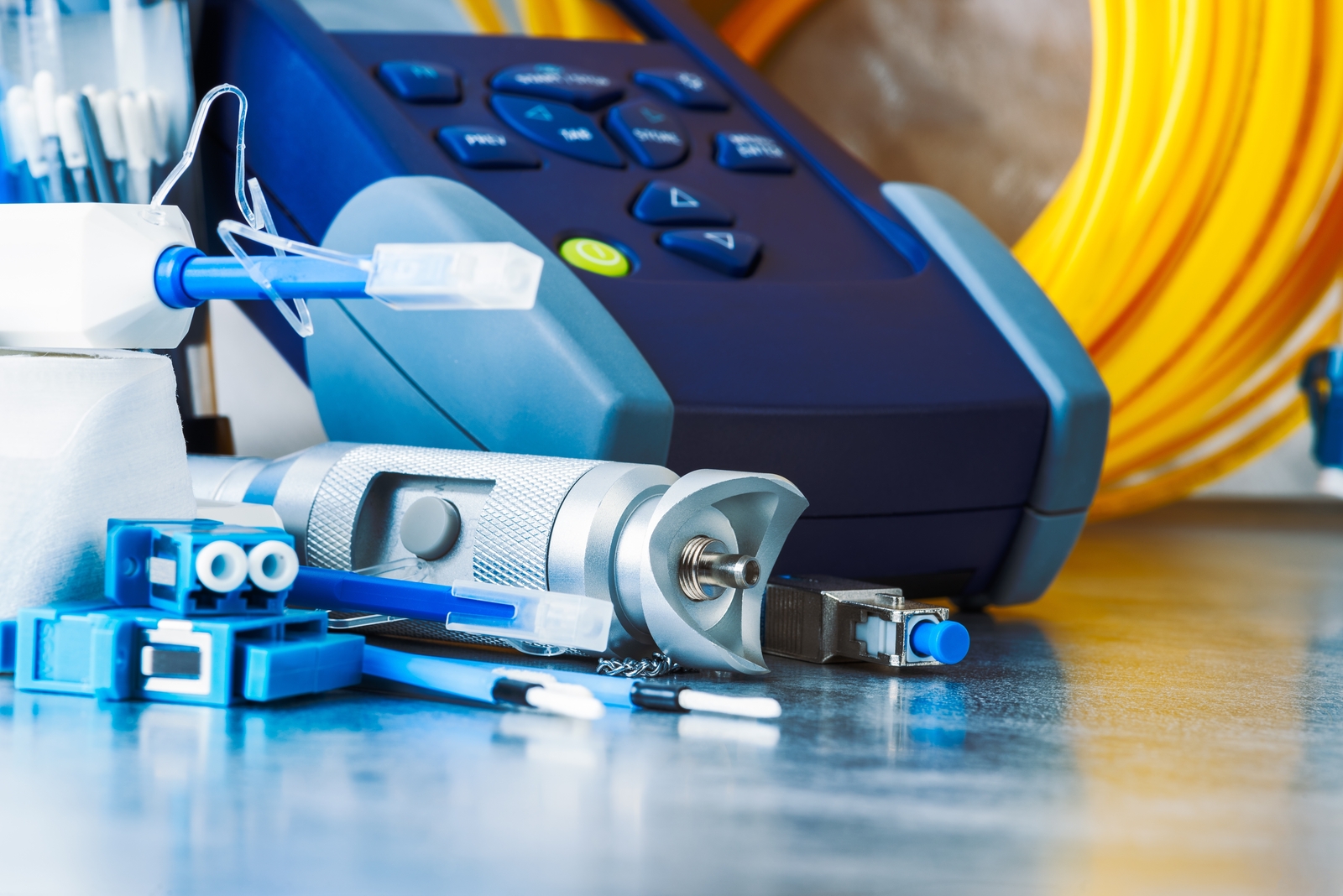
What Our Fiber Testing Includes in San Jose
Proof that every strand works, from technicians with hands-on technical training and a full fiber optics toolkit. When comparing testers, ask for an FOA certification or another training certificate.
Tier 1 loss certification
Light source and power meter readings on every strand, compared against a calculated dB budget, with polarity verified.
Tier 2 OTDR traces
A trace of each strand that shows where every mated pair, joint and bend sits and how much attenuation each one adds.
End-face inspection
Every end face scoped and cleaned before measurement, since dirt skews results and damages mating ports.
Splice verification
Fiber splicing results measured from both ends and averaged, which gives the true value an OTDR can’t show from one direction.
Fault location
Breaks, crushed sections, tight bends and bad terminations pinpointed by distance on existing runs.
Reports and records
PDF reports, native trace files and a test certificate for every strand, ready for your records, your project engineer and any manufacturer warranty.
Testing is the final step in every project we build. See our complete service.
Fiber service overviewTier 1 vs. Tier 2 Certification in San Jose
Both are defined in industry standards. Most backbones need both.
| Tier 1 (basic) | Tier 2 (extended) | |
|---|---|---|
| Equipment | Optic test set (light source and power meter) | OTDR, used along with Tier 1 testing |
| What it measures | Total end-to-end attenuation and polarity | Attenuation and reflectance of each event along the strand |
| Finds problems? | Shows a link failed, not where | Shows exactly where and what the problem is |
| Best for | Every new link, as the pass/fail standard | Backbones, campus links, joints and troubleshooting |
How We Get Accurate OTDR Results in San Jose
An OTDR is only as accurate as the setup and training behind it.
Launch and receive cables
Extra runs of glass added at each end so the OTDR can see the first and last mated pairs, which would otherwise be hidden in its dead zone.
Two wavelengths
Multimode is tested at 850 and 1300 nm, single-mode at 1310 and 1550 nm. Bends show up more at the longer wavelength.
Bidirectional testing
Strands with slightly different cores, common after splicing fiber from different makers, can make a splice look like a gain from one end. Testing both ways and averaging removes that error.
Pass/fail limits
Results are judged against your dB budget and ANSI/TIA-568 limits, such as 0.75 dB per mated pair and 0.3 dB per splice.
Reading Your San Jose OTDR Report
Your report shows a trace like this for every strand. Here’s what the features mean.
| Event on the trace | What it usually means |
|---|---|
| Reflective spike with a step down | A mated pair; the step shows its attenuation |
| Small step with no spike | A fusion splice or a bend |
| Larger drop at 1550 than 1310 nm | A macrobend or an overtightened tie |
| Large spike, then no signal | The end of the strand or a break |
| Steady downward slope | Normal attenuation over distance |
When You Need OTDR Testing in San Jose
Common testing jobs across San Jose and the surrounding cities.
New installs
Acceptance testing
Certification of every new backbone and campus link before you sign off.
Warranty
Manufacturer warranties
Test reports in the format manufacturers commonly require for extended system warranties.
Down links
Troubleshooting
Breaks and high-attenuation points located by distance so the fix goes to the right spot.
Existing runs
Audits and upgrades
Older strands tested before a speed upgrade to confirm they can support new optics.
Our San Jose Testing Process
Six steps from review to documented results.
Review
Our service technician confirms fiber type, run length, terminations, joints and the applications each link must support.
Loss budget
A pass/fail limit is calculated for every link from its distance, mated pairs and joints.
Inspect and clean
Every end face is scoped and cleaned before any test cord is attached.
Tier 1 testing
Attenuation and polarity are measured on every strand.
OTDR traces
Each strand is traced, in both directions where joints are involved.
Report
You receive PDF reports, trace files and a summary of any failures and fixes.
OTDR Testing FAQs for San Jose
Quick answers to the questions we hear most.
Do we need OTDR testing, or is Tier 1 enough?
Tier 1 is the standard pass/fail test for every link. OTDR testing adds technical detail and is recommended for backbones, campus runs, spliced links and troubleshooting.
Can an OTDR find a cable break?
Yes. It shows the distance to the break along the fiber cable, so we can go straight to the right spot in the building or conduit.
Why do you use launch cables?
An OTDR can’t see the first stretch of glass right after its port. Launch and receive cables let it measure the connectors at both ends of your link.
Can you test links another contractor installed?
Yes. We test existing and third-party installs and give you an independent report of what passed and what didn’t.
Related San Jose Services & Nearby Cities
Explore related pages, our other services, and the nearby cities we cover.
Nearby cities we serve
We also serve these 10 neighboring cities. Pick yours to see local service details.
Request a San Jose OTDR Testing Quote
Tell us the fiber type, number of strands, approximate distances and whether it’s a new install or a problem link. We’ll return an itemized estimate covering testing, reporting and any fixes.
C-7 Licensed Installer & Contact Details
San Jose Telecom Techs97 E Brokaw Rd, San Jose, CA 95112
Email: [email protected]
What to include in your request
- Single-mode or multimode, and strand count
- Approximate run distances and locations
- New install, warranty or troubleshooting
- Termination types at each end
- Target completion date